
What Is A Company-Let Agreement
If you've heard the term but aren't sure what it means — or how it differs from a standard tenancy — this guide explains everything you need to know.
As the rental landscape shifts dramatically in 2026, more London landlords are exploring alternatives to the standard residential tenancy. One arrangement that comes up frequently — but is often misunderstood — is the company let agreement. Here's what it actually means, how it works, and why it may be more relevant than ever.
The basic idea
A company let agreement is simply a tenancy where the tenant is a company or business, rather than an individual. Instead of renting your property to a person, you lease it to a corporate entity — which then takes responsibility for the property and any occupants within it.
In practice, a property management company such as Paréya Properties signs a lease directly with you as the landlord. The company becomes your sole tenant. Any individuals living in the property are occupiers of the company — not your tenants.
How it differs from a standard tenancy
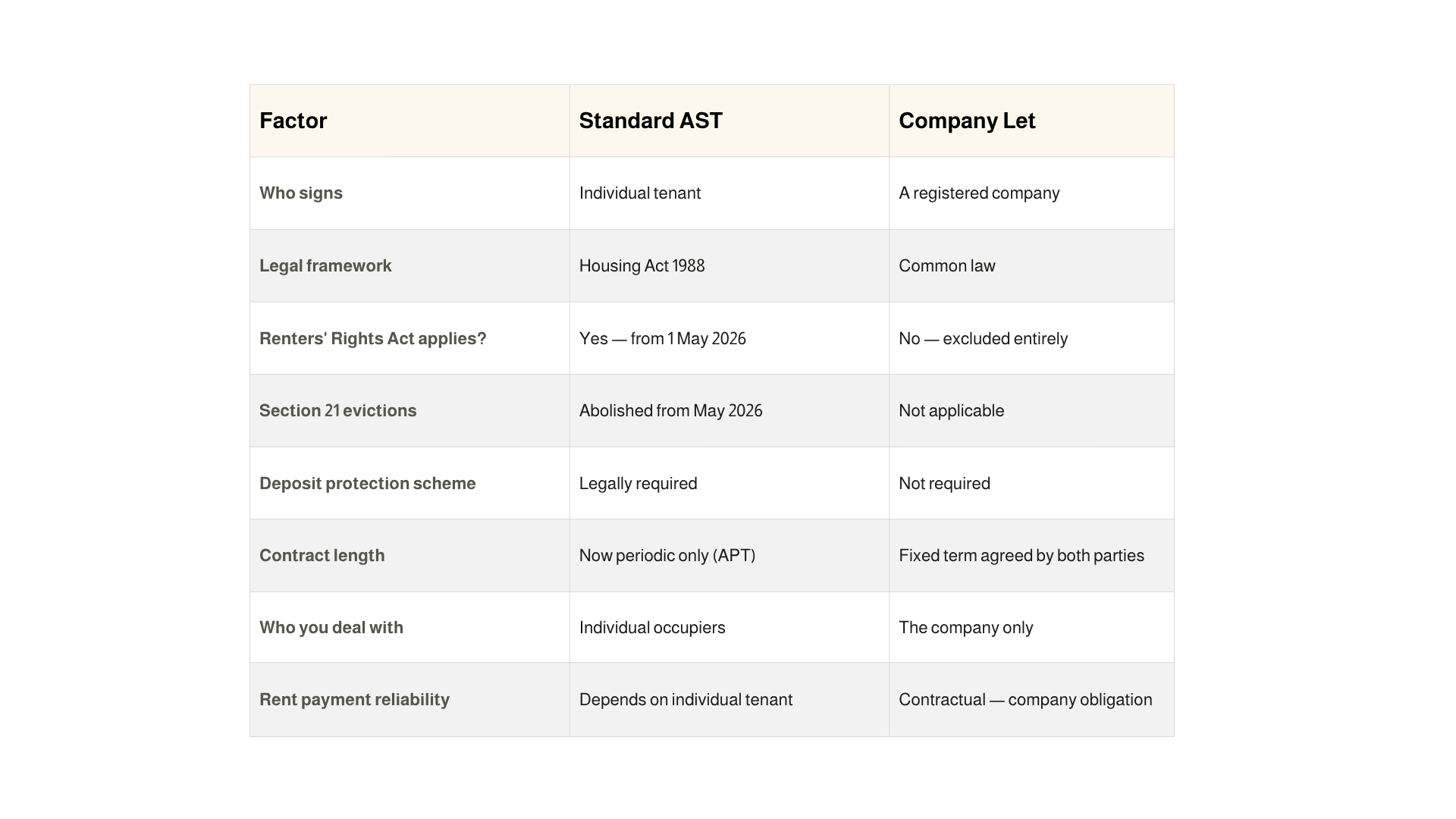
This is where most landlords find it confusing. A standard residential tenancy uses an Assured Shorthold Tenancy (AST), which is governed by the Housing Act 1988. A company let operates under common law — an entirely different legal framework with different rules, different rights, and different protections.
Why it matters more now
The Renters' Rights Act 2025, which takes effect on 1 May 2026, abolishes fixed-term ASTs, ends no-fault evictions, and converts all residential tenancies to rolling periodic agreements. For landlords operating under standard ASTs, this significantly increases void risk, reduces income predictability, and complicates possession.
Company lets are explicitly excluded from the Renters' Rights Act. A company let is among the agreement types that do not fall within the definition of existing tenancies under the Act — meaning the legislation's new rules on tenancy type, eviction grounds, and notice periods simply do not apply.

What a company let looks like in practice
When you enter a company let with Paréya Properties, the arrangement works like this:
We sign a fixed-term lease directly with you — typically for 2 to 5 years
We pay you a guaranteed, fixed monthly rent for the full term, regardless of whether the property is occupied
We source and manage all ocupants ourselves — you have no contact with, or liability to, the individuals staying in your property
We handle all day-to-day management: maintenance, compliance certificates, inspections, and tenant communications
At the end of the term, the property is returned to you in agreed condition
Your role is simply to receive your rent each month. Nothing else is required of you.
What to check before entering a company let
A company let is a sound arrangement when done correctly — but there are a few things every landlord should verify first:
Mortgage consent. If your property has a mortgage, check whether your lender permits company lets. Most buy-to-let lenders allow them, but it's worth confirming in writing.
Buildings insurance. Ensure your policy covers a company tenancy arrangement. Contents and liability insurance typically transfers to the management company.
The company's track record. You are entering a commercial agreement — treat it like one. Ask for references, check company registration, and review the lease carefully before signing.
Intended use of the property. A reputable company let provider will always confirm in writing how the property will be used and by whom.

Is a company let right for you?
A company let arrangement works particularly well for landlords who want a predictable, hands-off income without the complexity of managing individual tenancies — especially given the legislative changes taking effect in 2026. It is well suited to landlords with one or more London properties who prefer a commercial relationship over a residential one, and who value income certainty over chasing the highest possible headline rent.
If you prefer to be closely involved in your property and are comfortable navigating the new legislative landscape, a traditional letting arrangement may still suit you — though the risk profile has changed significantly.
